Creator content has become the main campaign strategy for the festive season. According to Meta, 94% percent of social shoppers now look to creators for guidance on what to buy, and 57% say that content directly influences their purchases. Social has drawn level with physical stores as the single biggest source of gift inspiration.
Social shoppers are not asking for a recycled autumn asset with a snowflake on it, they want original, holiday-specific content, and they want to see products actually in use, holiday unboxings, product reviews and real reactions.
In this article we’ve covered seventeen of the best Christmas social media campaign ideas of the last two seasons. Each entry covers what the brand did, results, the creative concept behind it, and how that becomes a creator brief.
TL;DR
The essentials:
- Utilize concept ideas from big brands, rather than production costs. A repeatable format works across a range of budgets.
- Budget in-person events for social media coverage rather than footfall. Most impressions and wins reported from pop-ups come from social media posts rather than from visitor numbers.
- Create a seasonal edition of an existing best seller. Co-developed with a creator and sold as a gift pairing, festive editions of your best sellers that your consumer already loves require no extra product education and raise basket value. The collaboration credit also gives the creator a reason to promote it.
- Agree paid usage before filming begins. An asset that cannot be licensed cannot run in the ad account.
17 of the Best Christmas Social Media Campaigns to Learn From
These are 17 of the best Christmas social media campaign ideas of the last two festive seasons, across beauty, fashion, retail, technology and marketplaces. They are grouped by creative concepts.
1. Gisou - Holiday Honey "Pup-Up" (December 2025)
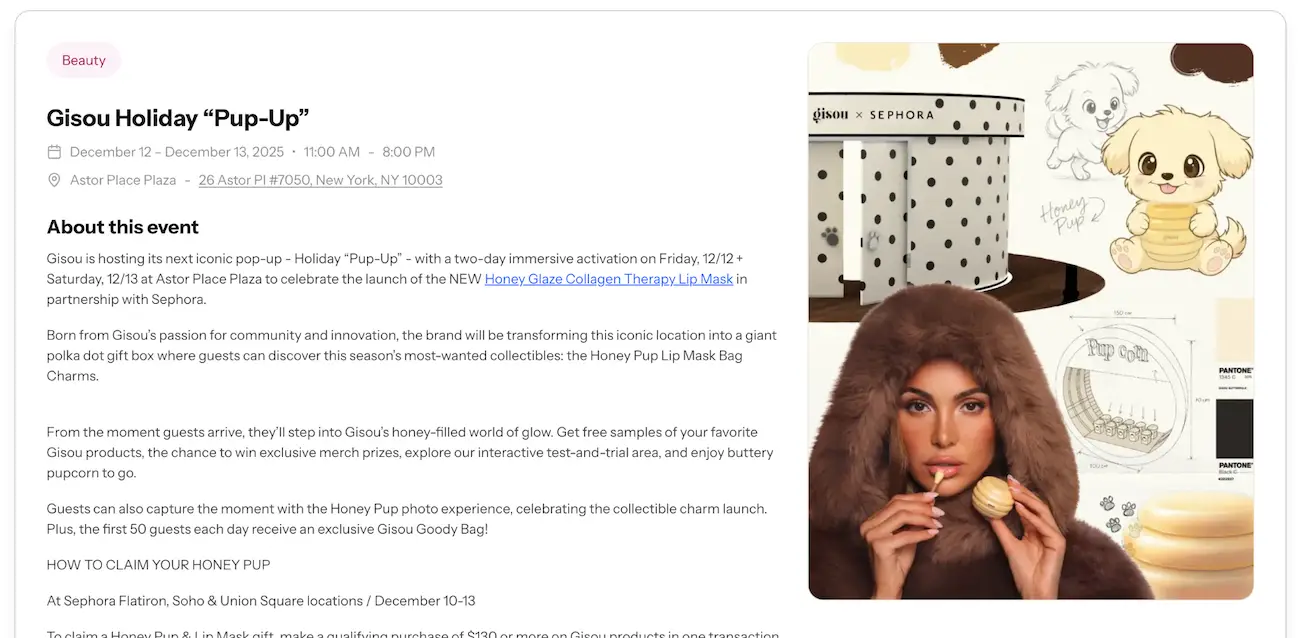
Gisou launched its Honey Glaze lip mask in December 2025 alongside a limited run of puppy-shaped bag charms, the Honey Pups. From 10 December, a $130 single-transaction spend at one of three New York Sephora stores earned shoppers a coin. On 12 and 13 December, a pop-up shaped like a giant polka-dot gift box opened in Astor Place Plaza, where visitors sampled products, collected free “pupcorn”, photographed the Honey Pup set, and redeemed their coins for a charm and lip mask gift.
Results: Coverage reports the Honey Pups sold out.
Why it worked: Visitors were photographing the product itself, because the collectible charm holds the lip mask. And since the coin required a $130 Sephora purchase to claim, the free pop-up produced sales the brand could measure.
The idea you can replicate: Design a collectible that holds or attaches to your hero product, then give it a photographable setting for 48 hours. Combine a desirable accessory, product sampling and a photo experience to encourage unboxing and visitor content.
2. ASOS - Winter Wonderland, SoHo New York (December 2025)
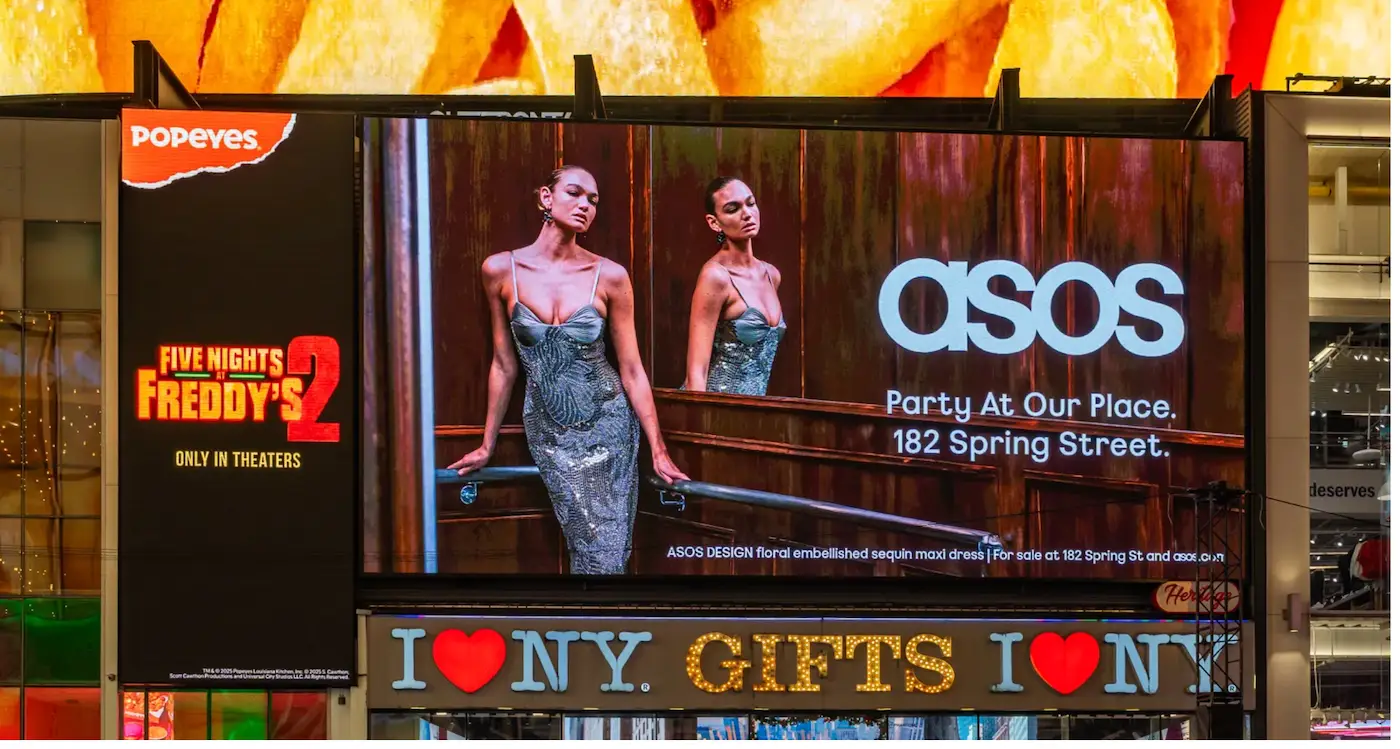
ASOS took its online-only catalogue into a SoHo space from 5 to 21 December, stocking ASOS Design, Arrange, ASOS Collective and the relaunched Topshop and Topman. Inside there was a cafe serving free drinks on proof of purchase, and free colour analysis sessions across two weekends. Paid out-of-home ran alongside the pop-up: a Times Square billboard, a takeover of an entire subway station, and a three-dimensional billboard with a glitter finish.
Results: ASOS published: almost 8,000 visitors, 231 social posts generating 31.8 million impressions, 11 influencers involved with a combined 7.45 million impressions, 26 pieces of press coverage worth 674 million impressions, and over 17 million impressions from out-of-home.
Why it worked: Fewer than 8,000 people visited, but 674 million impressions followed. This ratio is a great argument for a short, well-located pop-up. A few thousand visitors is enough, provided the event gives press and attendees something worth documenting. The hook that earned the coverage was Topshop and Topman returning to the US in person.
The idea you can replicate: Create a content destination. Combine festive shopping, personalised experiences and creator visits in a pop-up designed for sharing. Build a free personalised service into any physical activation. A styling session, colour match, engraving or scent profile produces an individual result worth posting.
3. JD - "Phones-4-Youse" launch party, Manchester (November 2025)
JD's Christmas ad was filmed entirely by its audience: 286 young people were given phones and asked to record their own lives, with no sets, rigs or lighting crews. To launch it on 6 November, JD dressed a Manchester pizza restaurant as a fake phone shop called Phones-4-Youse, with phones and iPads in glass display cases playing the clips around the dancefloor. DJ Josh Baker headlined and painted a mural on the shutters.
Results: None published.
Why it worked: Casting young people as the crew gave each of them a reason to share the finished ad. Filming without sets, rigs or lighting crews also removed a large cost in a Christmas ad. The launch used the same structure, playing contributors’ clips on screens around the venue so attendees were filming footage they appeared in.
The idea you can replicate: Unexpected venue transformation. Turn an everyday location into a festive cultural event that creators and guests want to film.

4. Jo Malone London - "Fun and Games" Tokyo pop-up (December 2025)
At its Tokyo pop-up, open 13 to 25 December, Jo Malone London ran a game of Plinko that could not be paid for. To play, a visitor posted a photo or video taken at the venue to their own Instagram or TikTok and showed it to staff. The venue was built to be filmed: an entrance maze, playing-card and chess motifs, photo booths, a ring-toss game. A parallel draw gave products to 30 winners who posted with the required hashtag.
Why it worked: Visitors paid for a game entry with a social post. Because the post had to be shot inside the venue, the set appears in all of them, so the activation is identifiable without a hashtag. A parallel prize draw reached people who did not attend.
The idea you can replicate: Price entry to a prize draw in social posts, not cash. Build one well-designed photographic setting, and make a modest prize contingent on posting from it.

5. Duolingo - "Owl on the Prowl" (November 2024)
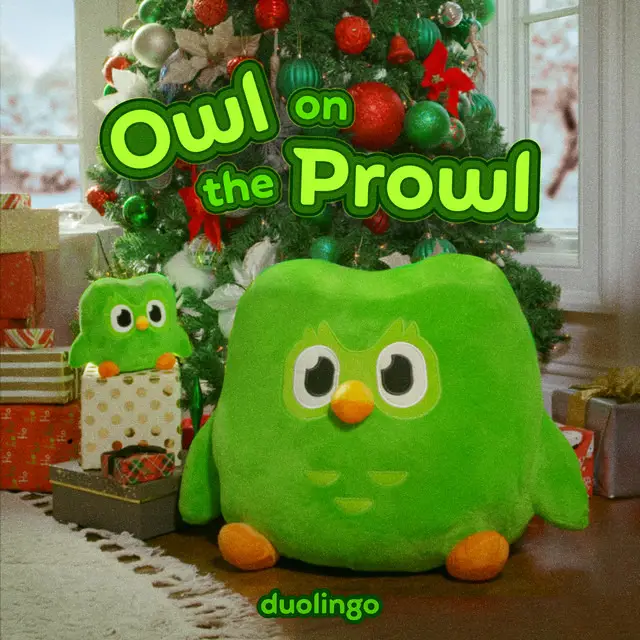
A four-track Christmas album on Spotify with an accompanying music video. The lead single, "Bring My Parents Back", written by The Gregory Brothers, is a Home Alone homage in which Duo the Owl abducts the parents of a boy who skipped his Spanish practice, then judges users naughty or nice by how consistently they study.
Results: "Bring My Parents Back" reported 3.75 million YouTube views in its first fortnight, rising past 4 million.
Why it worked: Duolingo’s users already joke about the notifications, so the villain premise needed no explanation, and a Home Alone homage is a frame most viewers recognise within seconds. Releasing it as music on Spotify and YouTube, rather than as a regular ad, put it somewhere less expected and people played it, which is where the four million views accumulated.
The idea you can replicate: Identify the trait your brand is already associated with and extend it into a seasonal format.
6. Google Pixel - "That's A Wrap", #BestPhonesForever (December 2024)
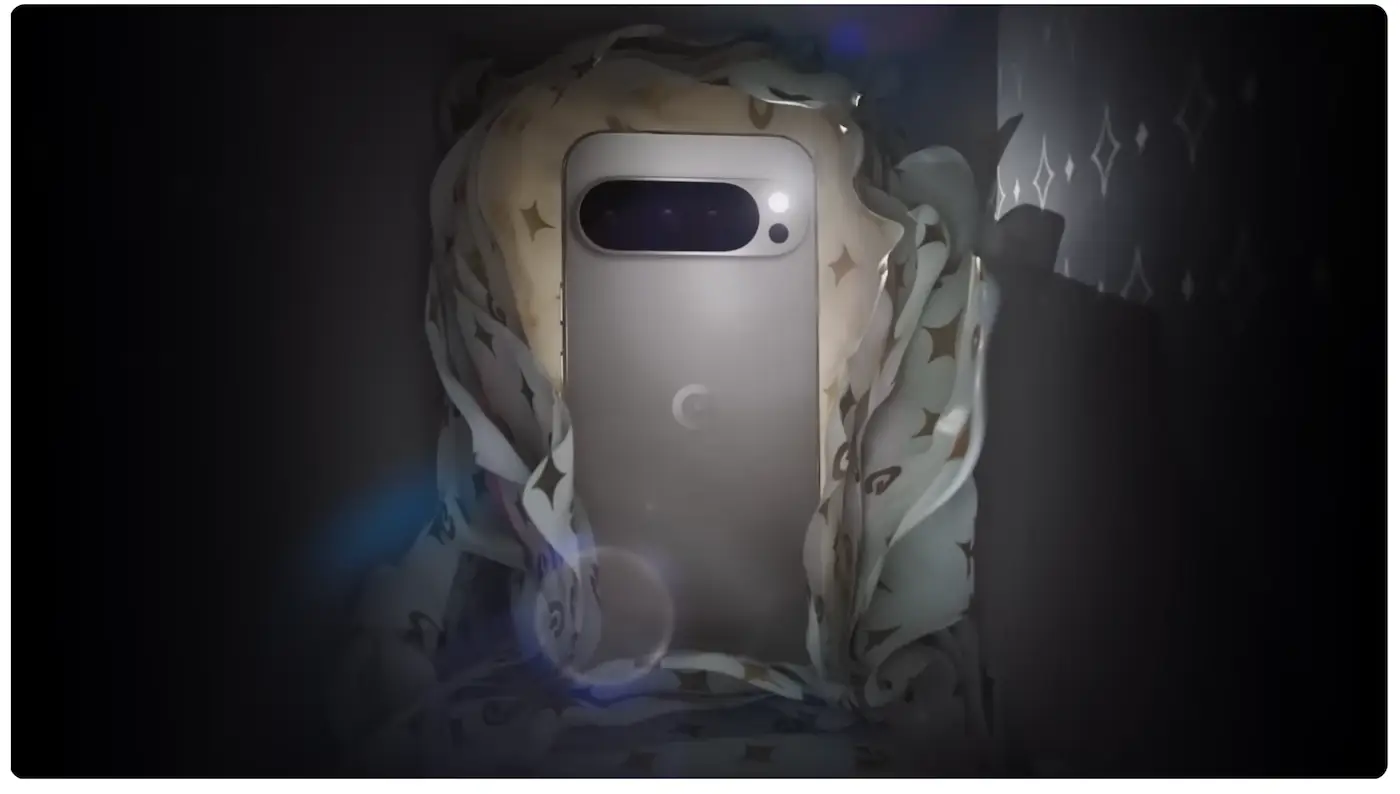
Two phones sit in separate gift boxes under a tree, torches on. The iPhone panics about being unwrapped, convinced it falls short without Gemini Live and Circle to Search. The Pixel works out where they are by asking Gemini about the clues around it (tissue paper, pine, carols), then reassures its friend that the holidays are about people who accept you as you are. It is one entry in a long-running series casting the two phones as friends.
Why it worked: The iPhone lists its own shortcomings, so Pixel never has to claim superiority. The demonstration is built into the story as well: Pixel asks Gemini to identify where it is, which is both the plot and the product working.
The idea you can replicate: Assign your products personalities and let a seasonal narrative demonstrate a feature in use. Reinterpret a familiar holiday tradition through your brand character, using original songs or recurring sketches.
7. Not On The High Street - "With Love" (Christmas 2025)
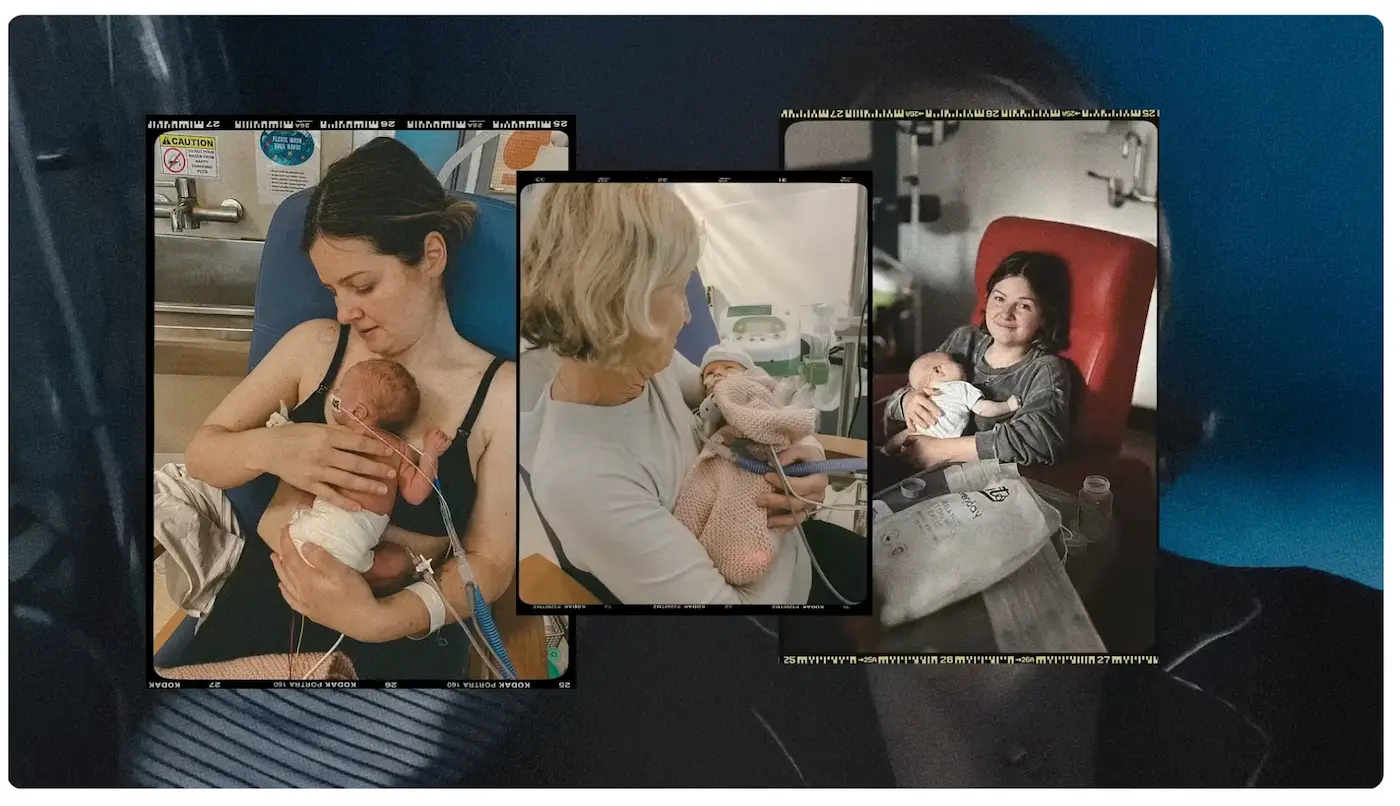
Three films, each narrated by a real customer over footage of the relationship behind a gift. In "New Mama", a grandmother gives her daughter a personalised photo bauble from a small seller, and the daughter's voiceover explains what her mother's support meant in early motherhood. The team listed life milestones, then ran a UK-wide casting call across customers, partners and staff. It was the marketplace's first in-house festive campaign.
Why it worked: Each film names a specific seller's product, so the narrative doubles as a catalogue entry. Casting real customers costs less than talent and reads as more credible, and in-house production gave the team control over revisions and timelines.
The idea you can replicate: Run a casting call through your own customer list to source genuine gifting stories, then build short films around the recorded account instead of the product. Pair genuine thank-you messages with product footage to reveal the personal meaning behind a gift.
8. Gap - "Give Your Gift" (November 2025)
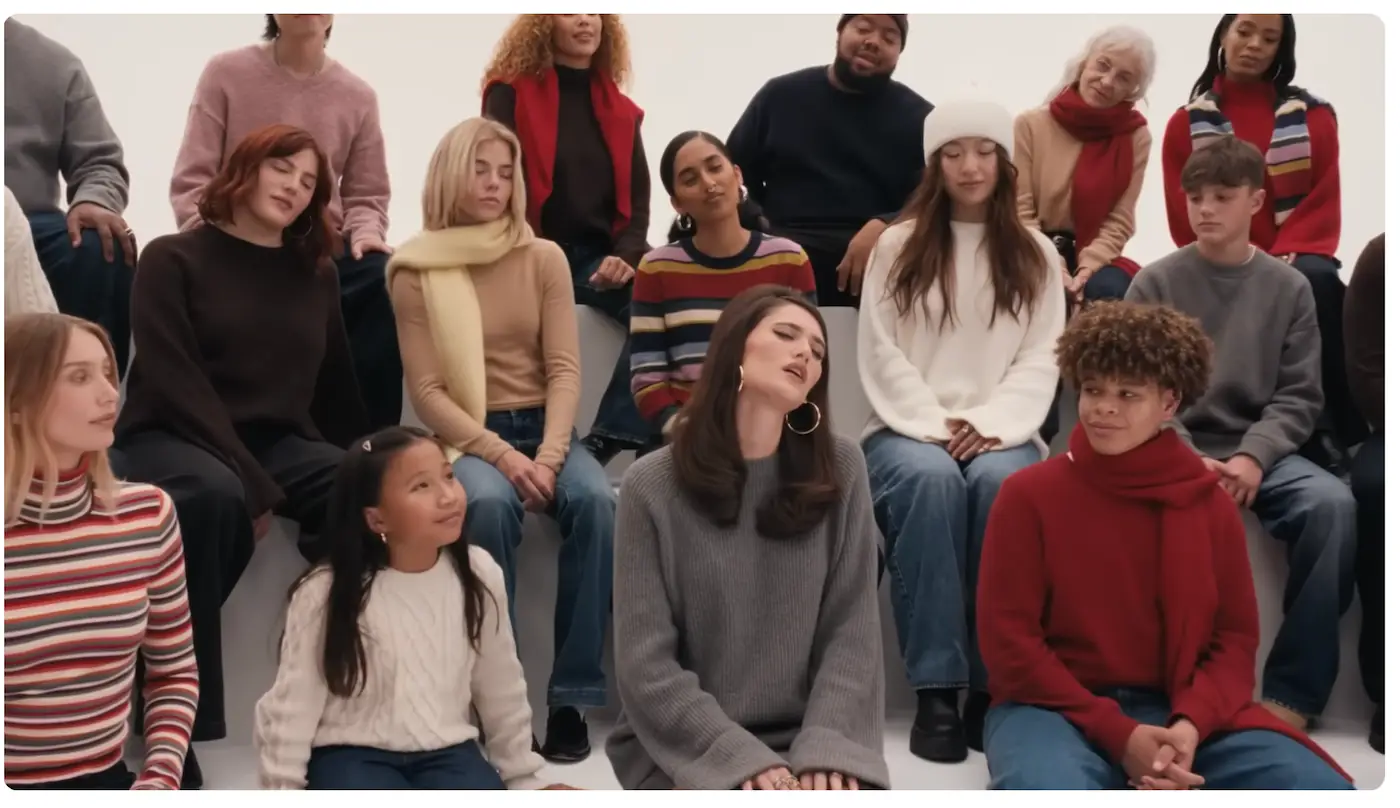
A ninety-second film, launched 4 November, in which 20-year-old London singer-songwriter Sienna Spiro covers Miley Cyrus's "The Climb" alongside a choir whose members range from 8 to 72. The idea: the gift you give is the strength you bring other people. It ran across digital, social and video, promoting Gap's CashSoft range and matching sets.
Why it worked: The casting states the idea without dialogue: a choir aged 8 to 72 shows that everyone has something to give. A well-known song performed by an unknown artist keeps the film familiar and the voice new.
The idea you can replicate: Build a performance piece around a community rather than a celebrity. Unite creators or community members around a familiar song, with your collection integrated into the performance.
9. Samsung UK - "A Friend for Christmas" (December 2025)
A girl unsettled after her family moves house describes her imaginary friend Milo to her grandfather, who sketches him on a Galaxy Tab S11 Ultra using Galaxy AI's Drawing Assist. On Christmas morning the family gives her a toy Milo. The film ran on socials and in cinemas, supported by a Samsung survey of 2,000 parents finding six is the age at which imagination is most vivid.
Why it worked: Drawing Assist solves the story’s problem rather than being demonstrated on its own, and the drawing becomes a physical gift by the end. The survey of 2,000 parents gives press something to cover besides the film.
The idea you can replicate: Give the product a defined role within a genuine problem. Bring a festive wish to life, build an emotional story around someone imagining something, with your product helping realise it.

10. Rhode x Matilda Djerf - Peppermint Glaze (December 2024)
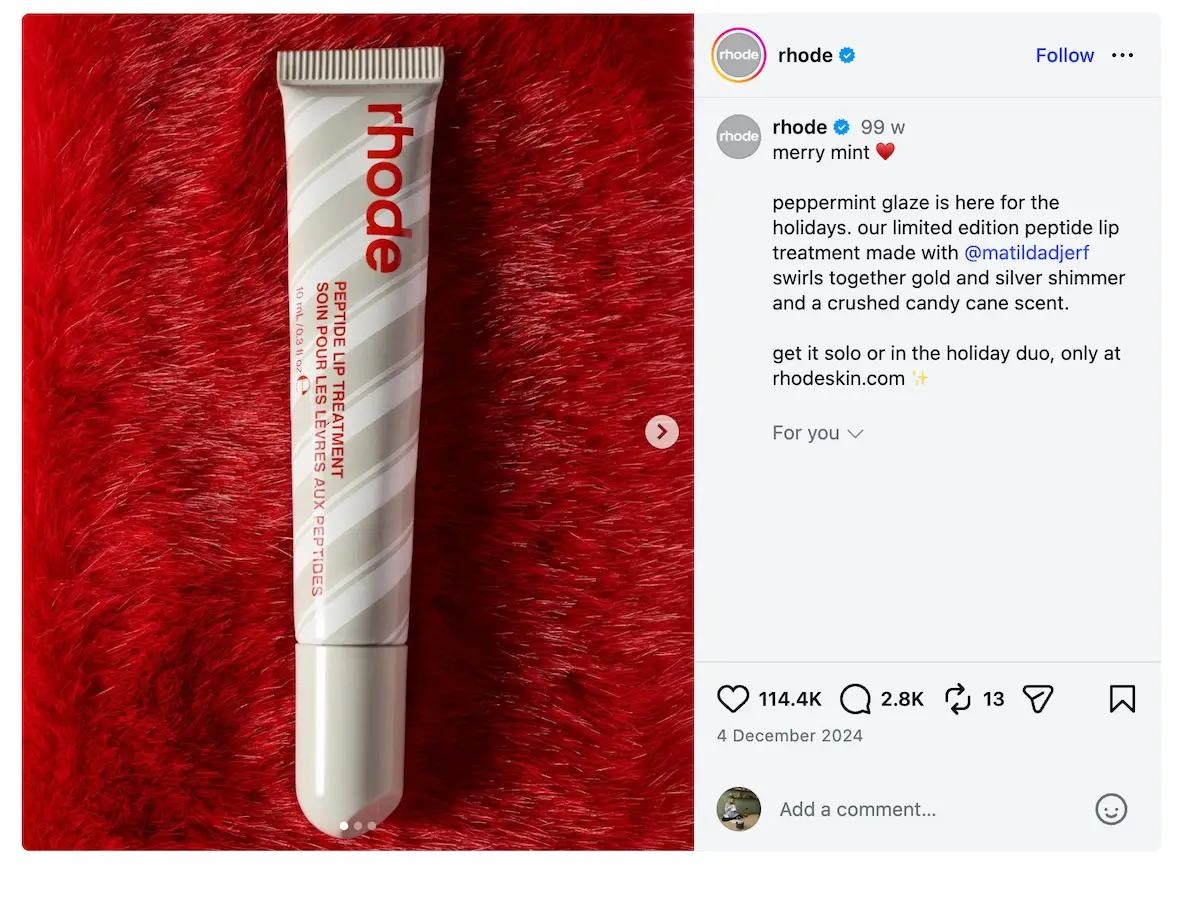
Rhode's first collaboration took its hero Peptide Lip Treatment and released a limited edition in Peppermint Glaze: frosty shimmer, crushed candy-cane scent, launched 4 December. Matilda Djerf co-developed the formula instead of simply fronting it, and the product sold standalone, as a Holiday Duo with a Glazing Milk, or in a larger bundle.
Why it worked: Extending an established bestseller removes the need for product education; the variant trades on recognition the brand already holds. The duo creates a pre-assembled gift at a higher basket value, and a co-development credit gives the creator a material stake in the launch.
The idea you can replicate: Take your best-performing SKU, produce one seasonal variation, and offer it as a pre-built gift pairing. Turn a recognisable Christmas flavour into a limited product, supported by festive creator imagery and tutorials.
11. Snapchat x Lancome, BOSS and Chopard - Winter Village (December 2025)
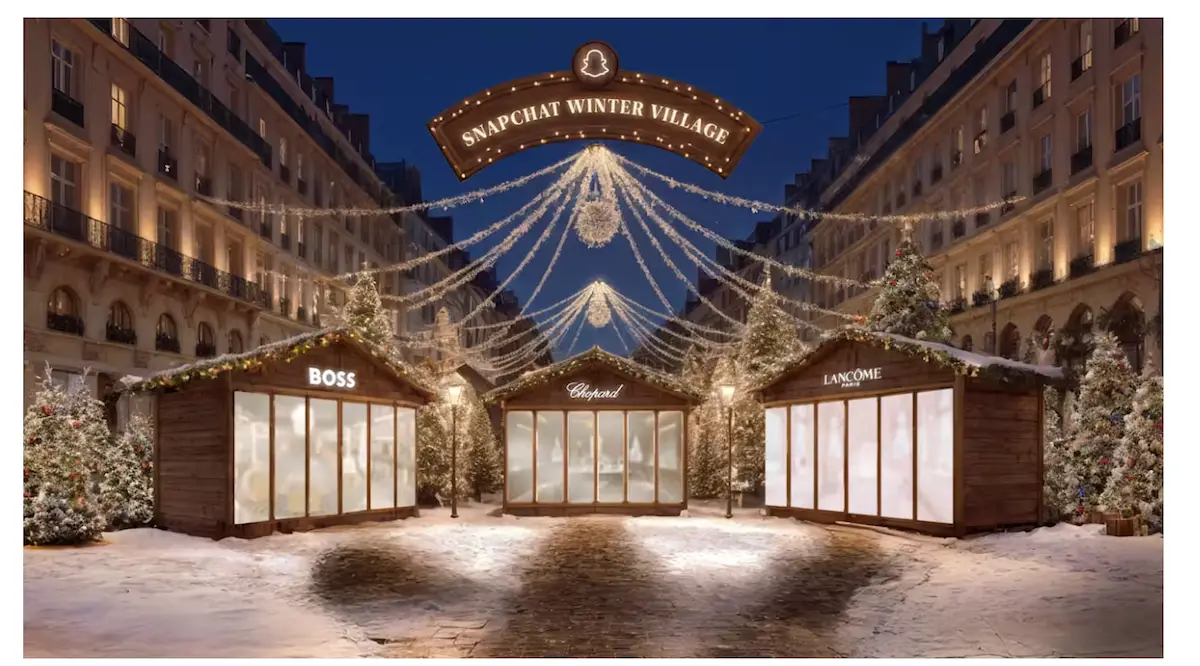
Three luxury houses shared one AR destination on Snapchat through December, across France, the US, the UK, Germany, the Nordics, Benelux and the Middle East. Users entered via the Lens Carousel or each brand's profile and explored three themed boutiques: an ivory room for Chopard watches, a train-inspired "Lancome Express" for fragrance, and a copper-walled "Augmented Factory" for BOSS x Steiff teddy bears. Purchases completed on each brand's own site.
Why it worked: A user arriving for one brand encounters the other two, a distribution exchange none could achieve independently. Each boutique centred on a different product category, so the AR had something specific to demonstrate.
The idea you can replicate: Interactive holiday discovery. Create a virtual festive destination where users explore products and move directly to shopping. Partner with two non-competing brands your customer already buys and build a single shared seasonal destination. Without AR, a joint gift guide or bundle achieves the same economics: production costs divided three ways against a combined audience.
12. Charlotte Tilbury x Celine Dion - "Star Confidence" (October 2025)
Charlotte Tilbury launched its Star Confidence fragrance with Celine Dion performing a re-recorded version of her 2002 hit "I'm Alive" on a cosmic stage called Planet Star Confidence. The film was seeded on Instagram and the brand site, and directly beneath it sat a "Shop Celine Dion's Makeup Look" carousel of ten products, from the foundation used to create the look through to the fragrance.
Why it worked: The film establishes the proposition and the carousel converts it, on a single page, with no navigational gap between them.
The idea you can replicate: Performance-to-look content. Build a festive beauty world around a performer, then translate the signature look into tutorials and product bundles. Place the shoppable version of the exact look directly beneath whatever festive content you produce.

13. Jacquemus - "Winter Retreat" (November 2024)
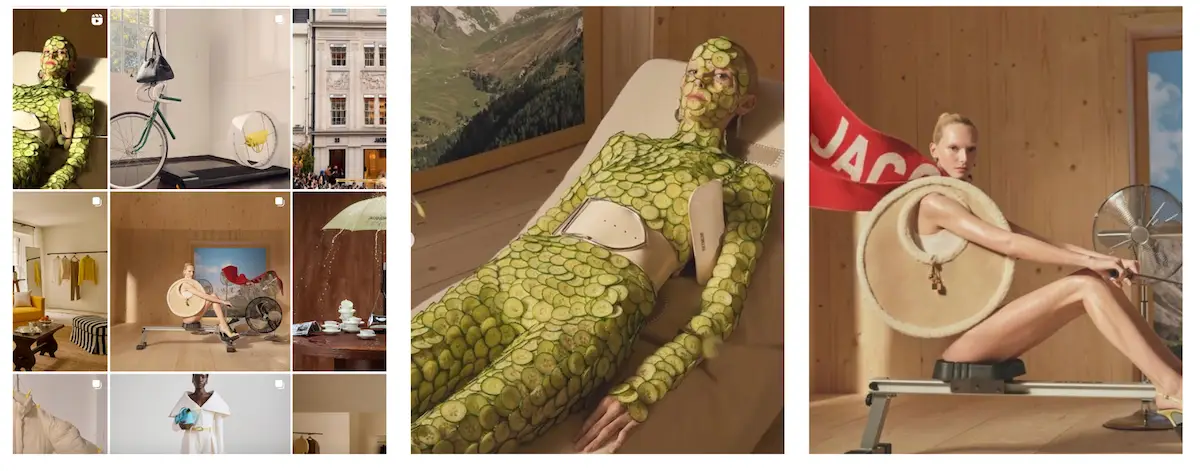
A limited-edition winter-wellness capsule shot as a ski-lodge retreat in cream, white and beige with one bold red look, starring Alex Consani. Alongside knit cardigans, sheepskin bags and a knitted eye mask sat a Trudon candle, Jacquemus-customised Moon Boots and deliberately odd household objects: wooden yo-yos, an XL Mikado set, matchsticks.
Why it worked: A tightly constrained palette makes every image identifiable as part of one campaign, allowing a grid to read as a coherent world rather than a sequence of posts. The unexpected objects give the audience something specific to comment on.
The idea you can replicate: Build holiday posts around a coherent retreat setting, distinctive styling and a personality your audience recognises.
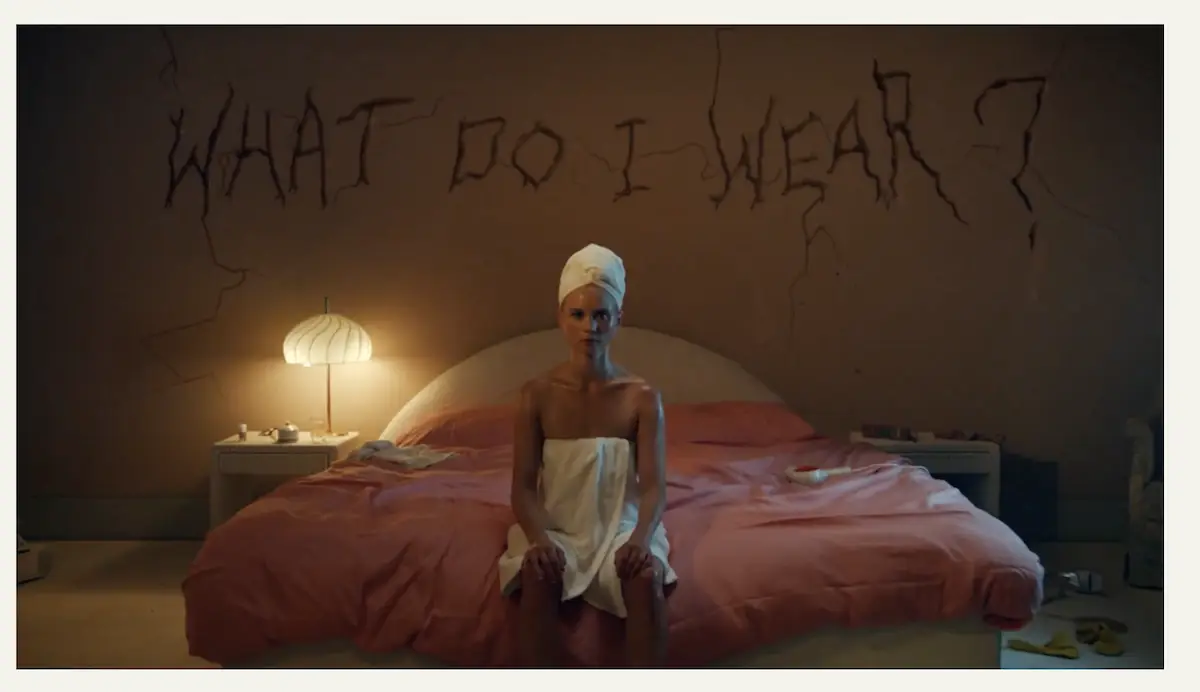
14. Zalando - "What Do I Wear?" (December 2024)
Zalando built its holiday campaign around one universal question and a single image to dramatise it: ‘the towel stare’, a person frozen on the edge of the bed, paralysed by a wardrobe they cannot face with several events coming in quick succession. Made by Mother Berlin and fronted by Sofie Eifertinger, it ran across TV, social and Zalando's Stories platform from 3 December, then switched in January to gym and wellness wear under the same question.
Why it worked: Owning a question rather than a product gives a brand a platform it can return to each season. The towel stare works because it depicts a specific, recognisable posture instead of a general feeling, and the January pivot demonstrates how far a single idea extends.
The idea you can replicate: Holiday dilemma series. Answer highly specific outfit questions through humorous videos and shoppable recommendations. Identify the question your customers ask themselves in December and build the season around it. Briefing several creators on distinct versions produces a series rather than a campaign with a fixed end date, and the same question can be re-briefed next year.
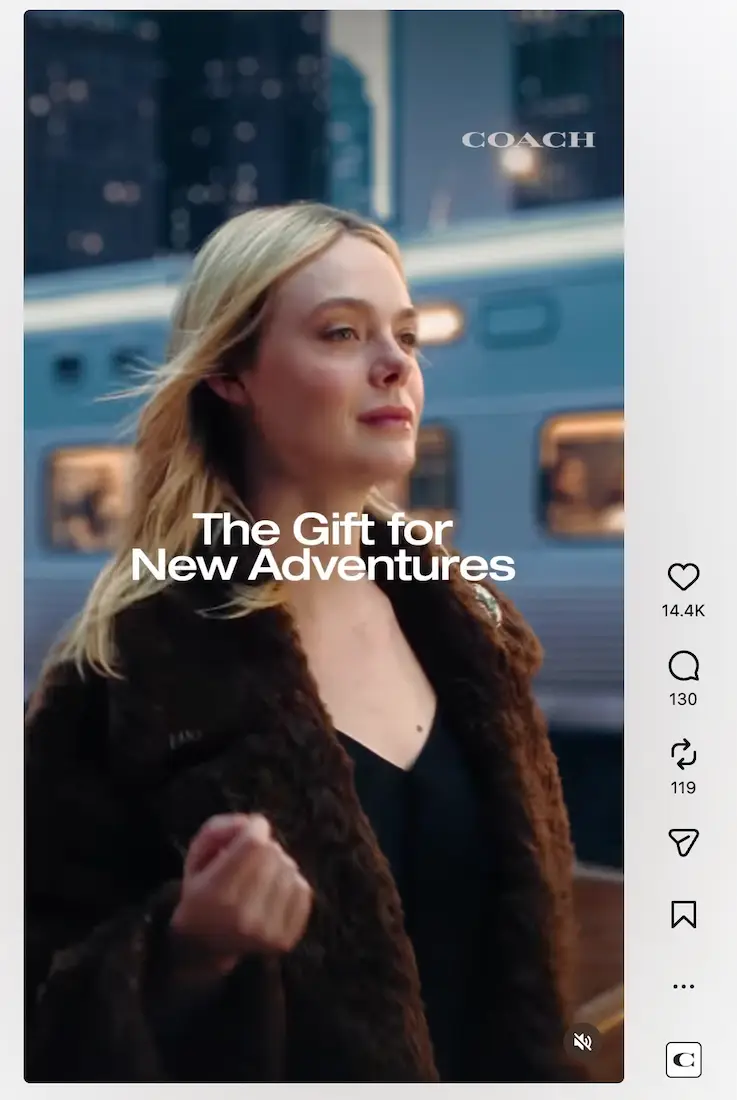
15. Coach - "The Gift for New Adventures" (November 2025)
Rather than one narrative film, Coach released short cinematic vignettes and stills by Dan Beleiu, published as Instagram reels. Each cast member, including Elle Fanning, Charles Melton, Koki, Soyeon, Griff and Ravyn Lenae, appears in a moment of change with a Coach bag as companion. Melton's has him getting ready in front of the Brooklyn Bridge.
Why it worked: Gifting is reframed from the handover to what follows it, which gives the product a role in a narrative instead of a close-up. A multi-market cast means a single asset set carries local relevance across the US, Japan, Korea and the UK.
The idea you can replicate: Show the gift’s next chapter - tell mini-stories about the first journey, celebration or milestone someone experiences with their present. Each creator brings their own audience and location.
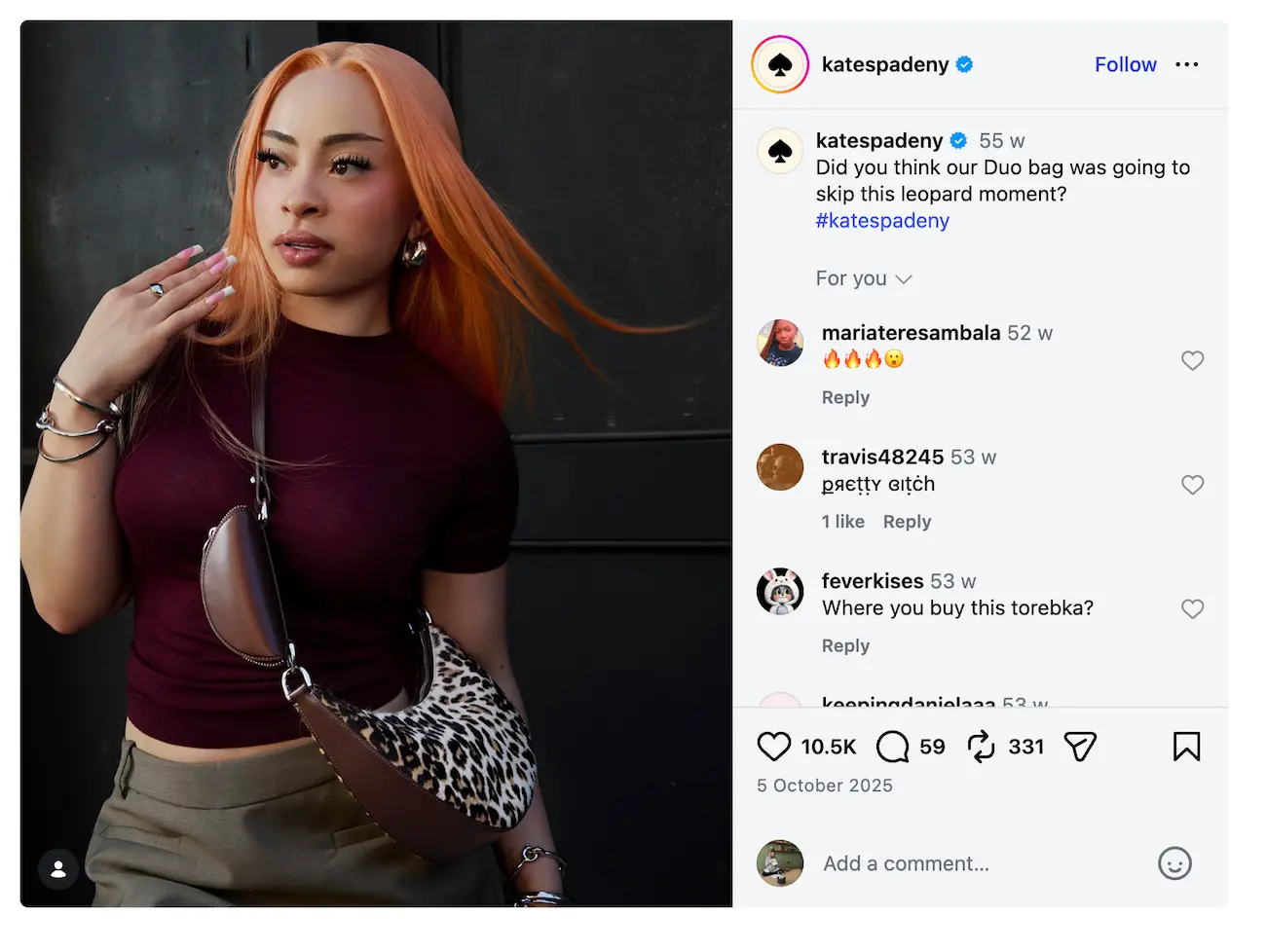
16. Kate Spade - "Spark Something Beautiful" and Holiday Duo-ets (September and November 2025)
Unveiled 23 September and running through February, the campaign is built around the Duo Bag and a theme of friendship, starring Ice Spice and Laufey. The theme runs through everything: celebrity duos for a Duo Bag, a 3D "DUO" installation on Fifth Avenue, then on 4 November a Holiday Duo-ets party with NYLON built around a snow sculpture of a jumbo Duo bag and the launch of the gift guide.
Why it worked: The product name generated the campaign. A bag called the Duo gave Kate Spade celebrity duos, a “Duo-ets” event and a DUO installation, so the concept came from merchandising rather than a separate creative brief. The holiday party also sat inside a campaign running from September to February, not a standalone December activation.
The idea you can replicate: Friendship-led creator pairings. Bring together contrasting personalities for festive performances, gift exchanges or styling content.
17. Naïma - "Favola di Bellezza" (November to December 2025)
The Italian beauty retailer Naïma returned to television with a dreamlike papercraft-style world combining live action and AI production, running 14 November to 24 December. The product anchor was the chain's first advent calendar, styled like a fairy-tale book. A loyalty contest ran alongside: spend EUR 69 and receive a postcard with a unique code for an instant-win draw, with three golden tickets worth EUR 1,000 each hidden inside 5,000 calendars.
Results: The brand stated a social and influencer reach target of over 2.5 million users.
Why it worked: The same visual idea appears in the film, on the calendar packaging and in store. The calendar gives the campaign a product to sell, and three €1,000 tickets hidden across 5,000 of them give buyers a reason to film the opening. Entering the €69 draw requires a loyalty card.
The idea you can replicate: Storybook product reveals. Use animated fantasy scenes around real product demonstrations to create a distinctive festive content series.

How to Use These Christmas Campaign Ideas for Your Brand
Some of these Christmas social media campaign ideas may look hard to replicate, but the question to ask of each one is which creative elements you could reproduce with creators and your available resources.
In each case that element is the action the campaign asked the audience to take. Identify the action, then specify the version of it you can brief. Jo Malone’s action is posting to earn a game entry. Zalando’s is answering one recognisable question.
The table maps each Christmas social media campaign above to a DTC-scale adaptation.
Three constraints determine which adaptations are feasible this season.
- Lead time. Briefing, filming and revisions take two to three weeks before an asset is ad-ready, so content commissioned in November is not available to run until late November or December.
- Rights. Paid usage rights have to be agreed before filming. Without it, an organic asset cannot be run in the ad account regardless of how it performs.
- Volume. Roughly 5–8% of Meta ads become winners, so a brief producing a single asset is unlikely to produce a winning one.
Our guide to ecommerce holiday marketing strategies covers the planning calendar, and how to run a UGC contest covers the entry formats behind several of the campaigns above.
For the wider seasonal plan, see our guide to holiday influencer campaigns for Q4 and Q5.
Run Your Christmas Social Media Campaign With Insense
Every creative concept above has the same gap between reading it and running it: research, casting, briefing, production and post. Insense Managed Service exists to close that gap, working as an extension of your marketing team instead of another tool to administer.
Insense handles research and strategy. Analysis of your existing ads, competitors and platform trends, the customer pain points and emotional motivators behind them, and a creative testing plan with concepts and scripts. After each round you get a performance review and creative recommendations.
Insense handles creator sourcing and production. You describe the creator profile the concept needs, covering demographics, tone, niche, platform focus and engagement, and utilise our influencer scouting service with a vetted network of 115,000+ creators across 57 countries. Onboarding, briefing, quality control, reshoots and replacements are all managed.
Insense handles post-production. Editing, captions and platform-native cuts with hook and CTA variations built in, delivered to your Google Drive ready to launch.
You keep the media. Ad launching, campaign structure, budget allocation, targeting and scaling stay with your team. You own the media, Insense owns the creative. Client involvement runs at roughly 5%: you approve concepts, creators and final deliverables.
Book a strategy call to work out which of these concepts suits your category, and what it would take to produce.