As DTC brands begin scaling their UGC ad campaigns, many scale the wrong things first. More creators, more briefs, more content, before the workflow behind them is built to handle it, and quality suffers.
Scaling UGC ad creative production at volume without losing quality means getting more high quality usable assets out of each creator partnership, whilst having robust production, analysis and feedback loops in place.
In this article, we cover the full production framework: how to plan, source, brief, edit, and test UGC at scale without quality or turnaround time degrading.
TL;DR
The key takeaway from this article:
- Scaling UGC production is a workflow problem, not a sourcing problem. More creators added to a broken process produces more overhead, not more usable ads.
- Each creator partnership should produce a library of assets.
- Modular briefs only work if hooks are visually distinct, not just verbally different. Meta's Andromeda system reads creative at the pixel level and suppresses redundant variants.
- The production loop closes when performance data informs the next brief.
What Does It Mean to Scale UGC Ad Creative Production?
Scaling UGC Ad Creative production means increasing the number of paid-social-ready assets you can produce, test, and run.
A few distinctions worth being clear on:
Content volume vs. usable ad volume: Ten creator videos does necessarily equate to ten testable ads. One creator project with three hooks, two CTAs, and raw footage for editing can produce 10+ testable variants.
Raw UGC vs. creator ads: Raw UGC is organic content produced for a brand's audience by a content creator. Creator ads or paid media UGC are assets built to run as paid placements. Partnership Ads (Meta) and Spark Ads (TikTok) run paid spend from the creator's handle rather than the brand's, which lowers CPMs and makes the ad feel native.
Workflow & creator access: Scaling UGC production is less about finding more creators and more about what happens after you find them. Be sure to implement a defined process for briefing, reviewing, usage rights, editing, testing, and feeding results back into the next batch.

One collaboration, multiple assets: A single creator engagement should produce a library, not a video. Brief for raw footage, multiple hooks, and variant-ready components from the start. That's what makes production scalable without a proportional increase in cost.
Why UGC Ad Production Breaks at Scale
UGC ad production breaks at scale when brands prioritize scaling creator volume over optimizing the underlying workflow.
Sourcing: Without a defined creator profile for each brief, sourcing becomes inefficient. You end up with creators who are available rather than creators who fit the angle.
Briefing: Briefs written for one finished video don't produce modular assets. At volume, a one-brief-one-video approach means a high cost per usable asset and nothing to test or remix.
Review: Without a structured review process, every round of revisions adds days. Building a checklist against the original brief as the review framework removes subjectivity from the process.
Usage Rights: Tracking usage rights across multiple creators in spreadsheets doesn't scale. Missing or expired agreements create gaps that slow down launches, restrict where content can run, or pull live ads mid-flight.
Editing: Raw UGC lands in disorganised folders and becomes unfindable. Editors spend hours hunting for clips. Media buyers can't match assets to performance data. The library grows but nobody can use it efficiently.
Testing: Production keeps generating new assets without knowing what the last batch taught them. Each cycle starts from scratch instead of building on the previous one. Creative velocity increases, but learning velocity doesn't without creative testing.
How to Scale UGC Ad Creative Production
Follow this five-step framework to scale UGC ad creative production:
1. Plan the Creative Batch Before Sourcing Creators
Before reaching out to a single creator, define what the next batch needs to test using creative strategy.
Pull your ad account data: highest CTR creatives, lowest CPA ads, fastest-fatiguing hooks, strongest-performing angles, and the customer objections that keep appearing in comments and reviews. Cross-reference with Meta Ad Library, TikTok, and Instagram Reels to see what's working in your category right now.
Turn that research into a specific production plan. Not "10 UGC videos." Something more like this:
A skincare brand planning a batch might specify: 3 creator types (dull skin, sensitive skin, close-up demo), 3 hooks per creator, 2 product angles (texture vs. results), 2 CTA options, and raw footage for future edits.
That structure makes the batch easier to test, easier to analyse, and easier to brief the next one from.
2. Source Creators Based on the Creative Plan
Once the production plan exists, source creators to fit specific roles within it.
The best creator for a brief isn't always one with the biggest audience, it's the one whose content category, delivery style, and audience demographics align with the angle being tested.
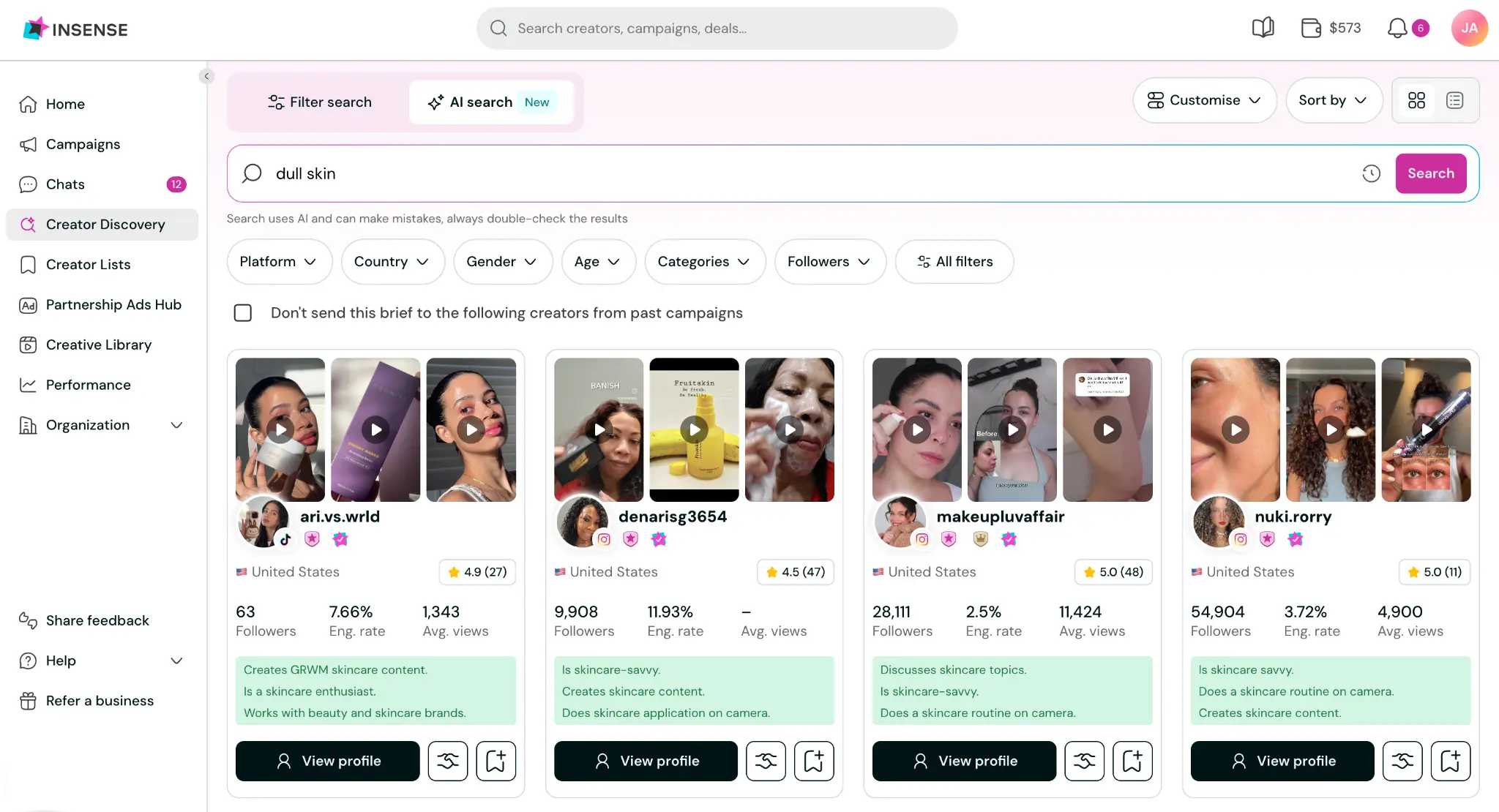
For a Vitamin C serum, for example, don't just source "beauty creators." Source by angle: a creator known for dull skin routines, a creator with a sensitive skin focus, one whose content is close-up skincare demos, another who posts busy morning routines.
Don't overlook your own customer base. A review request email with a video option, a post-purchase DM, or a community callout will surface people who genuinely use and like the product. Their content won't be polished and that's the point. Some of the highest-performing DTC creatives have come from seeded content that was never intended to run as an ad.
Other factors that predict usability at scale: natural on-camera delivery, ability to follow a brief without sounding scripted, reliability on deadlines, and any prior ad-style content.
Building a repeatable creator roster (a defined group the team has already vetted and worked with) removes the sourcing bottleneck from every subsequent batch.
Insense helps brands build a repeatable creator pipeline, with 115,000+ vetted creators filterable by category, audience, and content style.
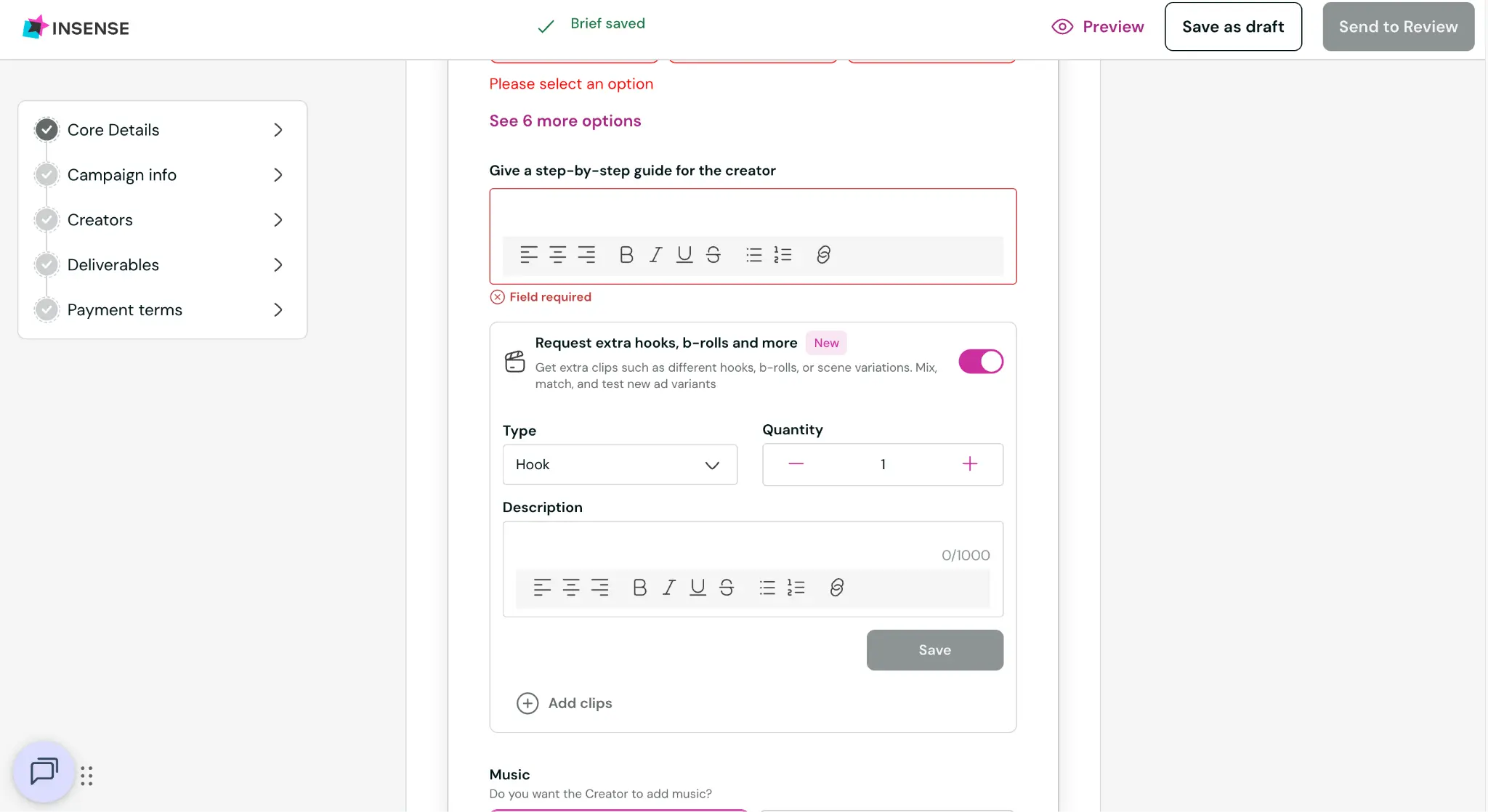
3. Brief Creators for Modular Footage, Not One Finished Video
A traditional brief asks for one finished video. A modular brief asks for the components needed to build multiple ad variations.
The difference in output is significant. A traditional brief yields one 30-second video. A modular ugc brief for the same creator yields three hooks, one product demo, two CTA closings, and raw b-roll. That's the raw material for 10+ distinct ad variations.
What a modular brief specifies: the hook format and three variations of it, the core product demonstration or claim, two CTA options, b-roll requirements, and raw file delivery alongside any edited cuts.
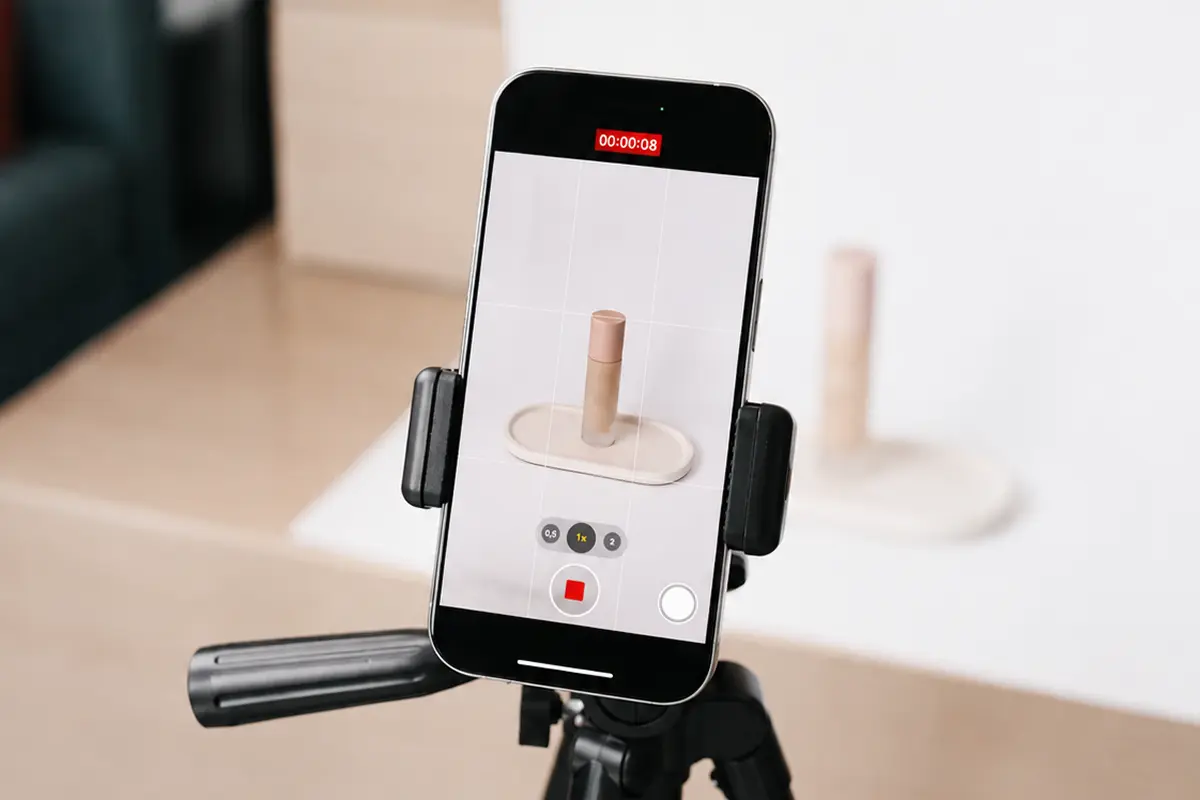
Script visual actions, not dialogue. The most common brief failure is over-scripting spoken lines and under-scripting what should happen on screen. A creator can find their own way to say "this product transformed my routine." They can't guess that they should be holding the product at a specific angle, showing the texture in close-up, or filming the before-state in natural light. Write each scene visually, not just verbally. Give the message to land; let the creator own the words.
Make hooks visually distinct, not just verbally different. Meta's Andromeda system reads creative at the pixel level. Two hooks with similar framing, location, and composition get treated as redundant and one gets suppressed, wasting the A/B test entirely. Hook 1 could be a handheld close-up in the kitchen. Hook 2 could be a wide outdoor shot or a different setting entirely.
4. Turn Creator Footage Into Multiple Paid Social Variations
Raw creator footage is source material, not a finished ad. The edit is where testable assets are created.
If six creators each deliver three hooks, one demo, two CTAs, and raw footage, the editing team can produce 30+ testable variants from a single production batch. Each variation is a distinct hypothesis: this hook, this creator, this CTA, for this placement.
Editing priorities for paid social:
- Strong first frame. The opening visual earns the stop before any audio plays. It needs to stop the scroll in a single frame.
- Hook in the first three seconds. The content proposition needs to be clear immediately. Anything that takes longer than three seconds to communicate what the video is about will underperform.
- Clear product visibility. The product should be visible and recognisable early.
- Captions and text overlays. A large share of paid social is watched on mute. If the key claim only exists in the audio, a significant portion of impressions never receive it.
- 15-30 seconds total. Short-form vertical 9:16 across TikTok, Instagram Reels, and Meta. On Meta in 2026, 7-15 second Reels are among the highest-performing placements.
5. Launch Small Tests and Use Winners to Brief the Next Batch
Don't launch every variation at once. Structure tests around one variable at a time: which hook structure performs best, which creator demographic converts, which CTA drives the most purchases.
Test variables to structure batches around: creator type, hook format, product angle, CTA, funnel stage, and platform. Each batch should be designed to answer a specific question.
Track the full funnel: hook rate and thumb-stop rate in the first 24-48 hours for creative attention, CTR for offer and angle performance, CPC for traffic efficiency, CVR for landing page and offer alignment, CPA and ROAS for full-system confirmation.
Set kill criteria before you launch, not after. On Meta, pull a creative when CTR drops 20-30% from its peak or frequency exceeds 3-4. On TikTok, refresh weekly. Brands that do see up to 37% lower CPMs over 30 days. Don't wait for the algorithm to tell you it's over; hook rate declining is an earlier and more reliable signal than CTR.
When winners emerge, brief variants of the winning format before scaling budget. Same angle, different creator. Same creator, different hook. Those variants extend the creative's useful life and give the next production batch a clear starting point, closing the loop that makes production genuinely compound over time.
Fast Tips for High-Volume UGC Ad Production
These are the operational fixes that make the biggest difference once production volume starts to increase:
Build a strict naming convention and file delivery structure. Ask creators to deliver content in three labelled folders: /raw, /hooks, /b-roll. Label each file by its modular component: hook_01.mp4, hook_02.mp4, cta_01.mp4. On the media buyer side, tag every asset by date, creator, hook type, and CTA. Without this structure, a growing asset library becomes unmanageable and performance data can't be matched back to specific creative components.
Use one-variable swaps for fast variation. Keep the core body video identical and swap only the first three seconds to generate hook variations. This is the fastest way to create structurally distinct test assets without additional shooting and it keeps the test clean.
Automate the legal bottleneck. Usage rights tracked in spreadsheets don't scale and create real risk. A centralised platform like Insense automates copyright transfers and usage rights agreements across the entire creator roster. One missing agreement can pull a live ad mid-flight; automation removes that risk entirely.
Use AI for initial hook testing. Before committing to a full creator shoot, use AI-generated avatars to test messaging and hooks at low cost. The hooks that earn stops at that stage are the ones worth briefing real creators on. It's a pre-production filter that significantly improves the yield rate of the actual production batch.
Final Takeaway
DTC brands producing UGC at scale without quality degrading have structured the production line so that every creator engagement produces multiple testable assets, every batch is informed by the previous one's results, and the workflow handles volume without breaking.
Insense is built to support that workflow end-to-end: creator sourcing, brief management, usage rights, and campaign tracking in one place. For teams trying to increase production velocity without losing quality, that infrastructure matters.
Over 3,500 DTC brands and agencies already use Insense to run UGC at scale. Book a demo or try it free today.
FAQs
Common questions from teams working on scaling their UGC ad production:
How many UGC ads should I test per month?
There's no universal number, it depends on budget, category, and how many angles you're testing. The more useful question is how many variants you're producing per creator.
What is the best way to scale UGC ad creative production?
Structure production in batches, brief creators for modular footage rather than one finished video, and edit for variation before launching. Combine that with a repeatable creator roster, a strict naming convention, and automated rights management, and volume becomes manageable.
Why is scaling ad creative so difficult?
Because most creative production workflows aren't designed for volume. The constraint usually isn't creator access or budget. It's the operational infrastructure around production.
.avif)